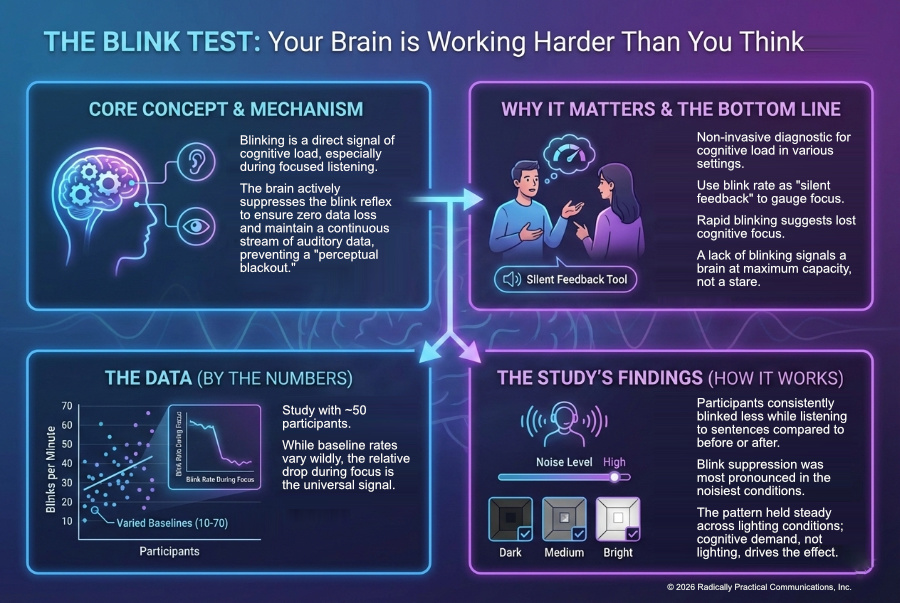
A new Concordia University study finds that blinking is a direct signal of how hard your brain is working to process information. When you’re focused, especially on listening, your eyes dry out because your brain is actively suppressing the blink reflex.
Why it matters
Blink rate is a non-invasive diagnostic for cognitive load in laboratory and real-world settings. This research moves beyond complex brain scans, offering a straightforward method to measure mental fatigue without interrupting the task. It gauges how well someone filters out noise to focus.
By the numbers
The study highlights that while baseline rates vary, the relative drop during focus is the universal signal.
-
There were almost 50 participants.
-
Individual blink rates varied from 10 to 70 times per minute.
-
The blink suppression pattern held steady in dark, medium, and bright rooms. Cognitive demand, not lighting, drives the effect.
How it works
Researchers measured eye blinks in adults listening to short sentences. The key variable was the signal-to-noise ratio (SNR).
-
Participants blinked less while listening to a sentence than before or after.
-
This blink suppression was most pronounced in the noisiest conditions.
-
The brain inhibits the trigeminal reflex to ensure zero data loss during high-stakes listening.
The takeaway
Blinking isn't random. It's a systematic response to important information.
Blinking creates a perceptual blackout. The brain suppresses this gap to maintain a continuous stream of auditory data. Previous studies treated blinks as a "nuisance" to remove from data. Researchers reanalyzed that data to focus on the timing and frequency of the blinks.
What's next
The researchers suggest suppression occurs because blinking is associated with losing information.
The next frontier is mapping the timing of information loss during a blink. Postdoctoral fellow Charlotte Bigras is leading that follow-up study.
The bottom line
If someone is staring intently without blinking, they’re not ignoring you. They’re working harder to listen.
Pro tip: Use blink rate as a "silent feedback" tool. If your audience is blinking rapidly, you've likely lost their cognitive focus.
In a high-stakes meeting, watch the eyes. A lack of blinking signals a brain at maximum capacity.
Go deeper: Blinking less signals the brain is working harder to listen →