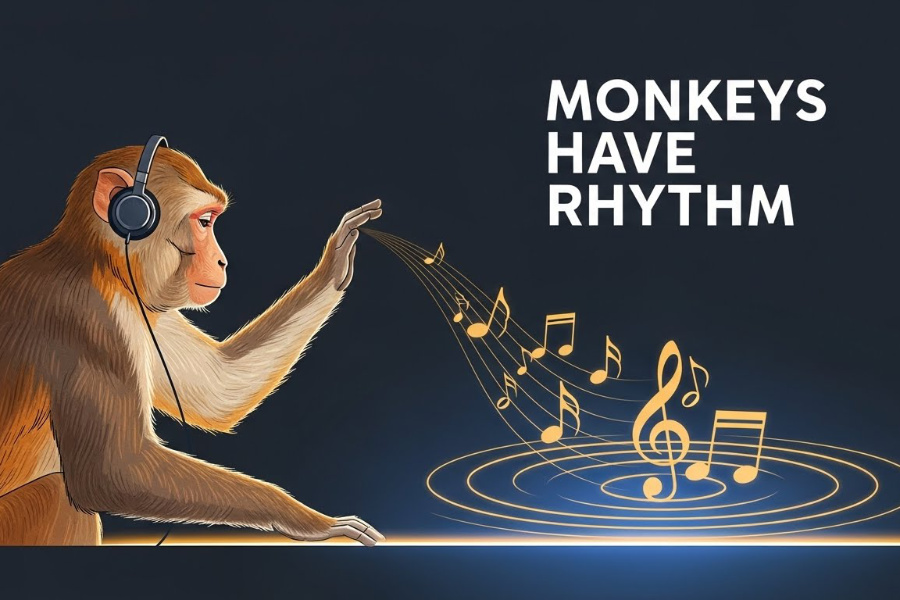
A new study in Science found that monkeys can keep a beat to human music. This might sound small, but it's a big deal for scientists. For years, researchers thought only certain animals could naturally sync up to a rhythm. Now, we're learning that the ability to feel music might be more widespread in the animal kingdom than we ever imagined. The roots of musical rhythm could go much deeper in our evolutionary history than we previously understood.
Why it matters
Scientists thought only vocal-learning species could perceive and synchronize to a beat. This finding breaks that link, indicating the cognitive foundations for rhythm may be more widespread.
1 big idea
The vocal-learning hypothesis has been a powerful theory. It posits that beat synchronization requires specialized brain circuits that link hearing and movement—circuits that evolved for complex vocal learning.
Macaques are not vocal learners. The fact that they can be trained to sync movement to a beat upends the idea that these specific vocal-learning circuits are a prerequisite.
The experiment
Researchers tested two macaques that had been previously trained to tap to a metronome.
- The monkeys heard three human-selected songs and received a reward for tapping to the tempo.
- They developed consistent tapping rhythms across all songs.
- When the music's tempo shifted, the monkeys adjusted their tapping, proving they synchronized to the musical structure itself.
Yes, but
The authors and outside experts carefully frame the findings.
- This is not natural behavior for the monkeys.
- The skill was conditioned through extrinsic rewards, not the intrinsic desire.
The bottom line
Beat perception may span a broader evolutionary continuum than our theories allowed.
The neural dynamics required for rhythm might be present in more brains, waiting to be unlocked with the right training.
This doesn’t mean monkeys experience music in the same way we do. It does mean the biological building blocks for rhythm are not the exclusive property of a few vocal-learning species.