Navigating the world without sight requires a finely tuned auditory map of your environment. Sound is a lifeline, a way of understanding spatial relationships and potential hazards. But a groundbreaking Johns Hopkins study has uncovered a critical vulnerability for people living with both vision and hearing loss: their auditory safety net is fraying, and the medical system seems unaware of the growing gaps.
Why it matters
Roughly 40% of patients seeking vision rehabilitation also have hearing loss. Clinicians are routinely treating only half the problem.
A difficult truth
Hearing aids don't help blind people navigate. Participants who used hearing aids reported no higher confidence or navigational skill than those who didn't. Current devices are engineered for speech perception. Spatial localization, the ability to locate objects and judge distance in an environment, is an entirely different neurological task. The market has not addressed it.
The study
-
58 adults participated with total or near-total blindness
-
30 self-reported hearing loss; 28 reported typical hearing
-
94% had received formal orientation and mobility training
An estimated 7 million U.S. adults live with vision loss; 30 million people ages 12 and older have bilateral hearing loss
The problem
Confidence matters as much as capability. Researchers used the DS-SLQ to measure participants' perceived navigational ability. What they found strikes at independent living:
-
Adults with early-onset hearing loss reported the lowest sound localization confidence of all groups, even after formal mobility training
-
Adults with early-onset blindness and typical hearing reported the highest confidence
-
Adding hearing loss to blindness dropped confidence measurably at every level
People aren't just struggling. They're avoiding complex environments that they are physically capable of navigating. The skill exists, but not the confidence.
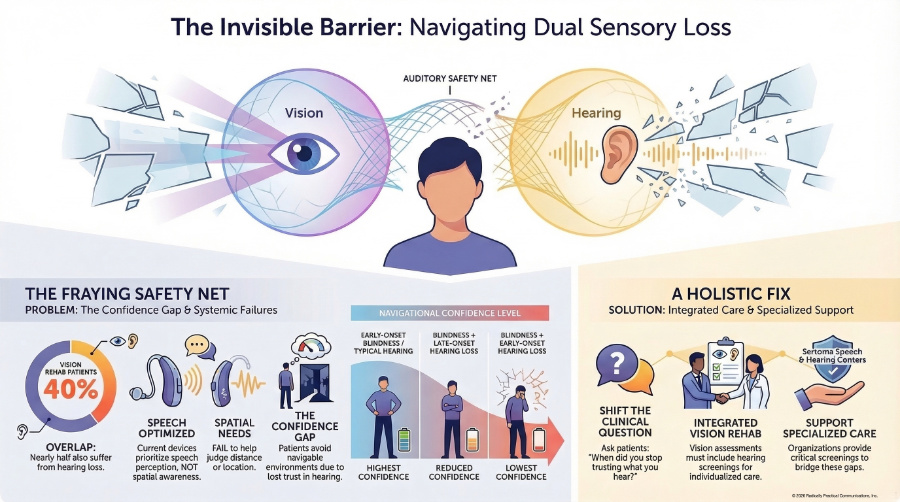 To download a PDF of this infographic, click the image.
Yes, but
This study depends entirely on self-reports. No objective audiological tests were used to measure actual localization performance.
-
Hearing loss is classified based on self-report and onset timing only.
-
Severity, type, and device quality are not controlled.
-
The sample includes only people with total or near-total blindness. Partial vision loss is a separate, open question.
The takeaway
Lead researcher Yingzi Xiong put it plainly: controlled lab studies don't capture why blind individuals with hearing loss hesitate to enter certain spaces despite having measurable skills. That hesitancy is the clinical problem.
Lead author Prachi Agrawal describes the fix: providers need to identify specific fears and tailor rehabilitation to address them directly. Individualized care, targeted at confidence gaps, is key.
- For patients, that means a different question at intake: not just "how well can you see?" but "when did you stop trusting what you hear?"
The bottom line
-
Vision rehabilitation would benefit from a holistic approach that includes hearing assessments during the initial visit.
-
Future research and clinical practice should explore the development of assistive technologies for spatial navigation, expanding beyond speech-focused hearing devices.
-
Using patient confidence as a metric would provide insights about outcomes and the patient experience.
Protect and preserve your hearing
Hearing loss doesn't mean losing your balance, social world, or increasing your risk of dementia. Our free 15-minute hearing screening will help you:
- Understand your current hearing health
- Prevent communication barriers
- Stay engaged with loved ones
- Maintain your quality of life
Schedule your free screening today and rediscover the sounds that matter most.
★ Call 708-599-9500 to schedule your free screening.
★ For facts about hearing loss and hearing aid options, grab your copy of The Hearing Loss Guide.
★ Sign up for our newsletter for the latest on Hearing aids, dementia triggered by hearing loss, pediatric speech and hearing, speech-language therapies, Parkinson's Voice therapies, and occupational-hearing conservation. We publish our newsletter eight times a year.
Don't let untreated hearing loss spoil your enjoyment of life.
Crest Hill, IL - 630-633-5060 | Palos Hills, IL - 708-599-9500