A new Rice University study challenges the assumption that people with vision loss can't judge traffic timing as well as those with normal sight. Researchers used virtual reality to test whether people with impaired central vision could judge when an approaching car would reach them. The results surprised them.
Why it matters
Clinical eye tests fail to predict real-world navigation skills. People with bilateral AMD performed as well as those with normal vision when estimating vehicle arrival times, which may reshape how doctors counsel patients about mobility and independence.
Physicians may be over-restricting mobility recommendations based on acuity scores that don't reflect collision judgment ability. This suggests rehabilitation programs should train both visual and auditory skills rather than compensating for vision loss with sound alone.
The backstory
Lead researcher Patricia DeLucia's research path started on childhood sports fields, where split-second collision judgments mattered. Decades later, she applies that curiosity to help people with visual impairments navigate safely. She's now a professor of psychological sciences at Rice University, leading multidisciplinary research across the U.S. and Europe.
“We wanted to understand whether people with impaired vision rely more heavily on sound and whether having both sight and sound provides an advantage compared to having vision alone. There are few studies that look specifically at collision judgments in people with visual impairments, even though tasks like crossing a street or navigating busy environments depend on this ability.” —Patricia DeLucia, PhD, Professor, Psychological Sciences, Rice University
How it works:
-
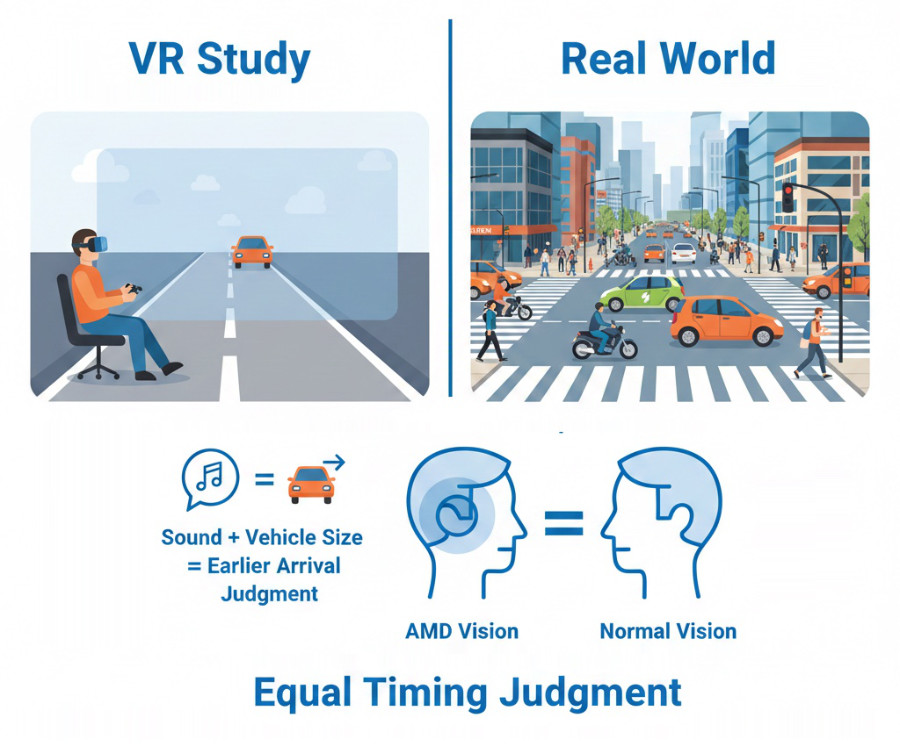
Participants experienced an approaching vehicle through sight, sound, or both in VR.
-
The vehicle vanished before reaching them.
-
They pressed a button when they thought it would arrive.
-
Researchers measured accuracy and identified the cues people relied on.
The study included adults with and without AMD, though specific participant numbers weren't disclosed.
Yes, but:
AMD patients didn't rely more on sound to compensate. They continued using both vision and hearing, even with damaged central vision, contradicting their initial hypothesis.
Even more surprising, adding sound to vision didn't improve accuracy. Lead researcher Patricia DeLucia expected a multimodal advantage, but it didn't happen.
Reality check
Both groups used the same perceptual shortcuts:
-
Louder vehicles are judged to arrive sooner.
-
Larger vehicles are judged to arrive sooner.
The AMD group relied more on these shortcuts, but researchers described the effect size as small, suggesting a minimal practical difference.
A difficult truth
Some people have severe retinal damage but reasonable visual acuity yet struggle with daily tasks like crossing busy intersections, navigating crowded sidewalks, or timing movements in parking lots.
Researchers don't fully understand the disconnect between disease severity and functional ability.
The challenge
Complexity makes real-world testing essential, but this study couldn't replicate it.
-
This study used a simplified scenario: One vehicle, one lane, no acceleration or deceleration.
-
Real traffic: Chaotic. Multiple cars. Unpredictable speeds. Quiet electric vehicles were not included in this research.
What to know:
- Don't let vision tests alone determine your mobility confidence.
- Complex traffic scenarios (highways, multi-lane intersections) remain unstudied.
- Electric vehicles may pose challenges due to reduced sound cues.
“People with impaired vision didn’t use just auditory information. They used both vision and audition." —Dr. DeLucia
The bottom line
- Patients shouldn't assume lab results guarantee real-world safety.
- The research opens doors to better rehabilitation programs and mobility training.
- It highlights the unknowns about vision impairment and real-world navigation.
- Future studies must test multi-vehicle scenarios, unpredictable driver behavior, and quieter electric vehicles before AMD patients can navigate complex traffic based on these findings.
Protect your hearing, preserve your connection
Age-related hearing loss doesn't mean losing your mobility, social world, or increasing your risk of dementia. Our free 15-minute hearing screening will help you:
- Understand your current hearing health
- Prevent communication barriers
- Stay engaged with loved ones
- Maintain your quality of life
Schedule your free screening today and rediscover the sounds that matter most.
★ Call 708-599-9500 to schedule your free screening.
★ For facts about hearing loss and hearing aid options, grab your copy of The Hearing Loss Guide.
★ Sign up for our newsletter for the latest on Hearing aids, dementia triggered by hearing loss, pediatric speech and hearing, speech-language therapies, Parkinson's Voice therapies, and occupational-hearing conservation. We publish our newsletter eight times a year.
Don't let untreated hearing loss spoil your enjoyment of life.
Crest Hill, IL - 630-633-5060 | Palos Hills, IL - 708-599-9500