New research reveals a counterintuitive twist in how children with hearing loss develop speech. While cochlear implants provide critical sound, turning them off might improve speech motor control for some users.
Why it matters
This finding upends the traditional understanding of speech acquisition. Matthew Masapollo, Ph.D., an assistant professor of communication sciences and disorders at the University of Oklahoma's College of Allied Health, found that while people with normal hearing rely heavily on sound to control their speech, cochlear implant users operate differently.
How it works
-
When audio is blocked, speakers with normal hearing become less precise.
-
Cochlear users get more precise.
-
This suggests that current therapies focusing solely on auditory feedback miss a massive piece of the puzzle: the sense of touch.
The big picture
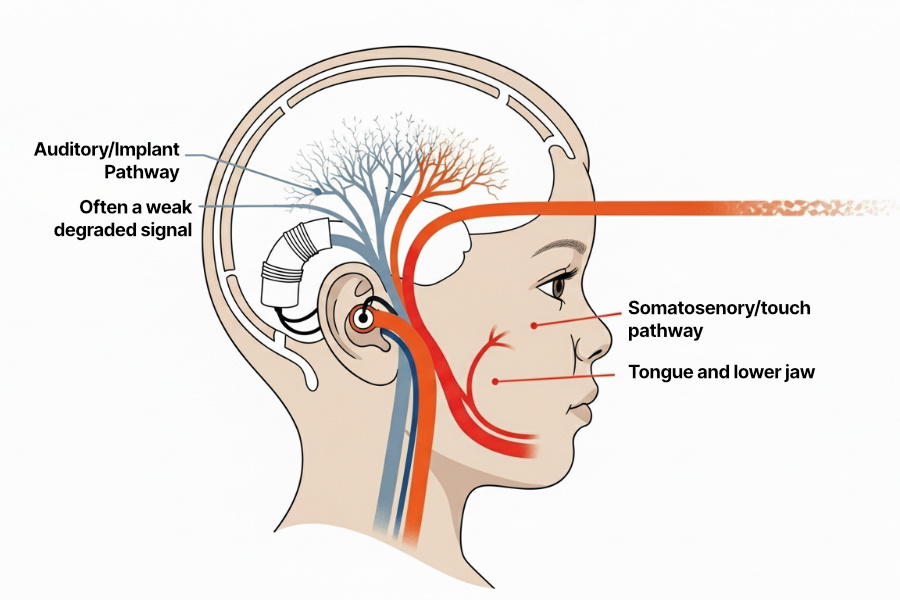
The brain is a compensation system. When clear auditory input is unavailable or degraded, it compensates by relying on non-auditory signals.
- Deaf people often compensate with lip reading, but that fails here.
- Many movements, particularly the tongue's, are hidden within the vocal tract.
- The sense of movement and touch (somatosensory feedback) must take over as the primary guide.
"When we produce speech, the lips, tongue, jaw and other structures are working in concert to shape the vocal tract and structure the acoustic signal. But many of those movements, particularly those involving the tongue, are hidden within the inner reaches of the vocal tract. So if a person can't hear the acoustic consequences of those movements, then the body's sense of movement and touch becomes even more important. Learning to make the most of that sensory feedback may be key." —Matthew Masapollo, PhD
A difficult truth
Speech is incredibly hard physical work. It requires the "choreography" of over 100 muscles working in concert. For example, simple exhale demands coordination from the larynx to the lips.
For children with implants, the audio signal is often degraded. This makes it difficult to link these complex mouth movements to the specific sounds they hear.
Dr. Masapollo and colleagues use electromagnetic articulography (EMA) to map these hidden mechanics in the following way:
-
Researchers attach copper electrodes to the subject's lips, tongue, and jaw using dental glue.
-
A magnetic field tracks these sensors to create a 3D video of the vocal tract moving.
-
An ultrasound probe under the chin provides a secondary view of the tongue.
-
Dr. Masapollo collaborates with Mark Mims, MD, to administer sensory nerve blocks to verify the reliance on touch. This anesthetizes the vocal tract to isolate how the lack of feeling impacts speech control.
The bottom line
If this hypothesis holds, the gold standard for teaching deaf children to speak needs an update.
-
Future interventions shouldn't chase better hearing alone.
-
They must include oral motor training using therapies that help children feel the mechanics of sound production to unlock their full speech potential.
"There is still so much to understand about how a person learns to control the movements of their vocal tract in service to speech. That's why it's important for us to study ways to help children achieve their full potential if they are born deaf." — Dr. Masapollo
Concerned about the speech problem?
A screening with a speech-language pathologist will help you understand:
- Your current speech challenge
- Ways to prevent communication barriers
- Staying engaged with loved ones
- Maintaining your quality of life
★ Call 708-599-9500 to schedule your free screening.
★ For facts about speech-language pathology and treatment options, grab your copy of The Hearing Loss Guide.
★ Sign up for our newsletter for the latest on Hearing aids, dementia triggered by hearing loss, pediatric speech and hearing, speech-language therapies, Parkinson's Voice therapies, and occupational-hearing conservation. We publish our newsletter eight times a year.
Don't let speech challenges spoil your enjoyment of life.
Crest Hill, IL - 630-633-5060 | Palos Hills, IL - 708-599-9500