Nearly one in five adults with tinnitus have reduced hours or quit their jobs. Research published in Brain Sciences by Anglia Ruskin University concludes that tinnitus is more than an annoyance: it's a career-ender for some.
What to know
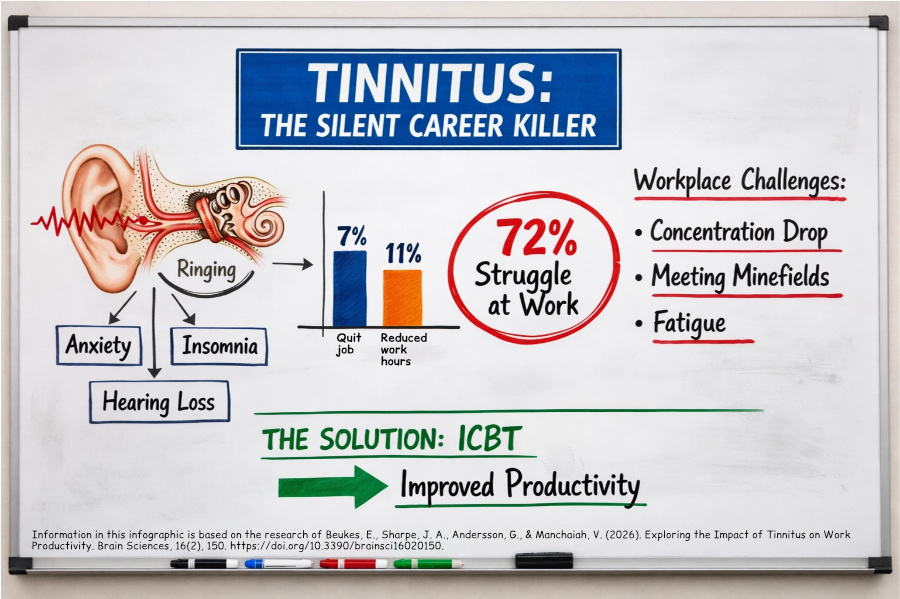
Tinnitus is the perception of ringing, buzzing, or hissing without external noise. It rarely appears alone—it often co-occurs with hearing loss, anxiety disorders, or chronic insomnia, compounding workplace challenges. Severity ranges: some experience mild distraction, others face debilitating symptoms.
Why it matters
Tinnitus affects 15% of the population (8 million UK adults). The NHS spends £750 million annually ($891 million) treating it. Workforce exits compound the problem.
By the numbers
- 7% of surveyed adults quit their jobs due to tinnitus.
- 11% reduced their working hours
- 72% described tinnitus making work harder when asked open-ended questions—suggesting the problem runs deeper than multiple-choice surveys.
- 449 working adults participated in the study.
The challenge
Workers describe brutal workplace realities. They struggle to concentrate. Meetings become communication minefields. Fatigue piles up. Errors multiply. Tasks take longer. Some need to leave team meetings early or avoid phone-based tasks entirely.
The indirect hits compound the problem: anxiety, insomnia, and frustration. Many withdraw from team interactions.
Here's the encouraging part: Internet-based cognitive behavioral therapy (ICBT)—an online program teaching coping strategies for tinnitus management—produced meaningful improvements.
After the program, fewer participants required reduced hours. ICBT also reduced tinnitus distress, anxiety, depression, and insomnia. Participants felt better equipped to cope at work.
Reality check
Lead researcher Dr. Eldré Beukes cautions that the results are preliminary. The study lacked a control group, so the findings need confirmation.
"Workplaces should recognize tinnitus as a condition that can affect productivity and may require reasonable adjustments. Policies supporting flexible work patterns, access to hearing-related technologies, and improved manager awareness could help those affected stay in work." —Eldré Beukes, PhD, associate professor of audiology, Anglia Ruskin University
The bottom line: Employers need to wake up. As workplaces push for return-to-office mandates, open-plan offices and noisy environments create hostile conditions for tinnitus sufferers.
What employers can do now
-
Offer noise-canceling headphones or white noise machines.
-
Allow flexible scheduling around fatigue patterns.
-
Provide quiet workspaces or remote work options
-
Train managers to recognize when employees need accommodations.
Timely intervention can prevent workforce exits and save the economy from losses.
What's next
Employers can contact Tinnitus UK for workplace assessment tools or talk to occupational health teams about reasonable adjustments.
Protect your hearing, preserve your peace of mind
Stress and hearing health are deeply connected. If you're experiencing tinnitus, hyperacusis, or hearing changes alongside high stress levels, our free 15-minute hearing screening can help you:
- Understand your current hearing health
- Identify potential stress-related auditory issues early
- Access resources for managing tinnitus and hearing concerns
- Maintain your quality of life and mental well-being
Schedule your free screening today and take the first step toward better hearing health.
★ Call 708-599-9500 to schedule your consultation.
★ For facts about hearing loss and hearing aid options, grab your copy of The Hearing Loss Guide.
★ Sign up for our newsletter for the latest on Hearing aids, dementia triggered by hearing loss, pediatric speech and hearing, speech-language therapies, Parkinson's Voice therapies, and occupational-hearing conservation. We publish our newsletter eight times a year.
Don't let untreated hearing loss spoil your enjoyment of life.
Crest Hill, IL - 630-633-5060 | Palos Hills, IL - 708-599-9500