Millions lose hearing to noise damage and aging. Now, biologists at UC San Diego's Department of Cell and Developmental Biology have built an AI system that renders 3D views of the tiny hair cells responsible for hearing. It works 50 times faster than humans analyzing the same images by hand.
Why it matters
Gene therapies are already restoring hearing to children born deaf, according to Manor's lab, treatments that are expected to grow. But researchers need a faster way to measure whether the treatments work at the cellular level. VASCilia delivers that speed.
Reality check
VASCilia is a lab tool, not a clinical diagnostic. It gives researchers the speed they need to validate treatments before they reach patients.
The big picture
Stereocilia work as harp strings. Longer ones pick up low frequencies; shorter ones catch high pitches. When loud noise, aging, or disease disorganizes these bundles hearing degrades.
VASCilia detects and measures subtle distortions that humans miss.
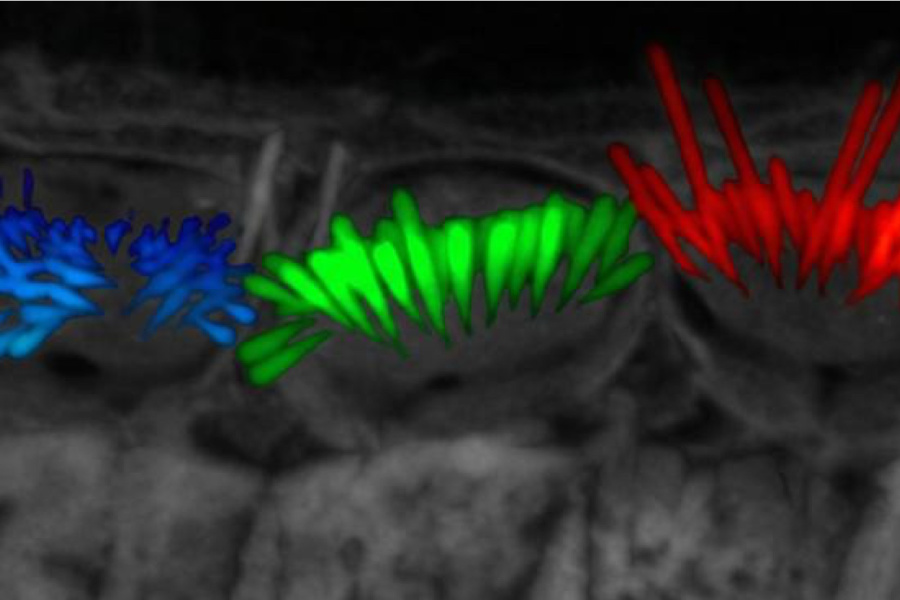 Hearing researchers require detailed images of stereocilia, the bundles of protrusions that detect sound and movement. The red hairs featured on the right were rescued to full length due to gene therapy, while green-intermediate hairs received partial treatment and blue received no treatment. Photo credit: Manor Lab, UC San Diego.
How it works
- The tool uses five deep learning models trained on expert-annotated mouse cochlear datasets to automate image interpretation.
- It analyzes stereocilia, the hair-like protrusions that detect sound frequencies.
- Years of manual work now happen in minutes.
- Researchers trained the system on expert-annotated datasets, the gold standard for teaching AI to recognize cellular damage patterns.
The backstory
Postdoctoral researcher Yasmin Kassim, a Schmidt AI Fellow, led the build. Her computer science background let the team automate what biologist Uri Manor calls "a slow and labor-intensive process."
Manor's lab studies how stereocilia bundles fall apart after exposure to construction noise, jet engines, or concert speakers.
The tool offers new measurements, such as the orientation of individual cells, revealing alignment failures that manual analysis overlooks.
Zoom in
In gene therapy experiments, VASCilia distinguished cells that received full treatment (restored to normal length) from those that received partial treatment or no treatment.
Manor's team can now measure stereocilia disorganization after blasts of sound from jet engines or construction sites, the exact environmental stresses that cause permanent hearing loss.
What's next
The team expects VASCilia to adapt across species and imaging methods, accelerating clinical trials for hearing-loss drugs.
The bottom line
VASCilia is open-source and published in PLOS Biology. Researchers want it to evolve into an atlas of cochlear images across species and imaging methods.
That will speed hearing loss research for people dealing with noise damage or age-related decline.
"We want to understand exactly how this is happening." —Uri Manor, PhD, Chancellor’s Endowed Chair in Biological Sciences, UC San Diego