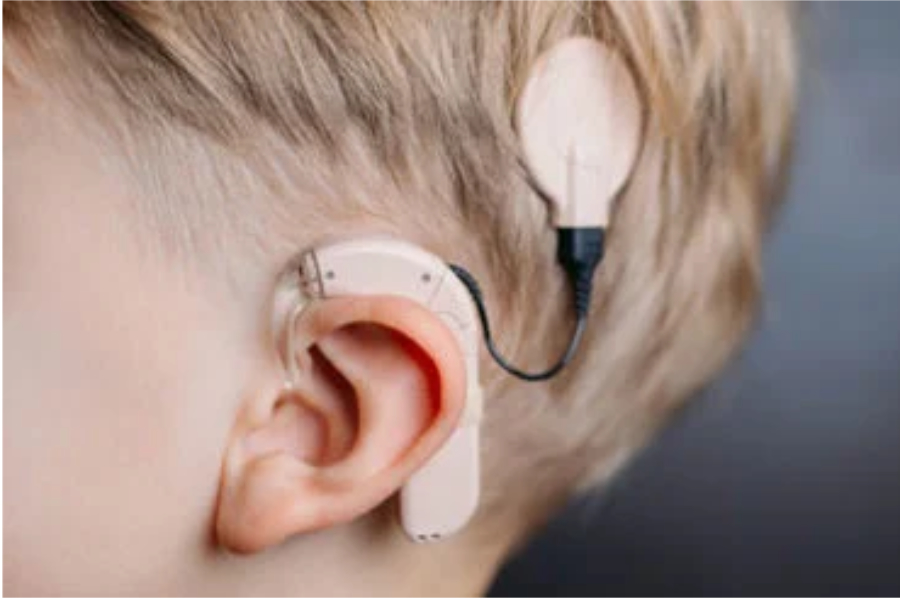
A groundbreaking study reveals a stark divide in how children with cochlear implants develop communication skills. Research from Ann & Robert H. Lurie Children's Hospital studied 176 children who received cochlear implants before age three. It revealed unexpected patterns about who succeeds with spoken language.
Why it matters
Your family's income level dramatically shapes whether your deaf child's spoken language becomes their primary communication mode. communicate through speech after getting a cochlear implant — far more than the language you speak at home.
By the numbers
- Among commercially insured children, 85% communicate primarily through spoken language.
- For kids on Medicaid, just 33%, a difference of 52 percentage points between families with higher and lower incomes.
Assumptions, assumptions
You might think speaking Spanish or another language at home hurts a child's chances of developing English speech skills. The research says otherwise. Family language — whether English only, bilingual English/Spanish, or Spanish only — didn't significantly impact speech outcomes.
The big picture
This finding challenges what many medical professionals might assume. Dr. Nancy Young, who led the study, explains that implant programs shouldn't view non-English family languages as roadblocks to speech development. The data supports her conclusion.
Yes, but
Non-English speaking families are more likely to have lower socioeconomic status, which does impact outcomes. So while the language itself isn't the problem, the economic circumstances often accompanying it can be.
A closer look
Why does money matter so much?
- Socioeconomic status affects language and literacy development in all children, not just those with hearing challenges.
- Wealthier families typically have more resources — time, access to specialized therapy, educational support — that help children develop spoken language skills.
- Bridging the socioeconomic divide calls for targeted action. For example, a proven strategy is coaching parents on interactive communication strategies. These techniques combine visual and verbal approaches to encourage spoken language development.
"More research is needed on how to best intervene to improve language outcomes in children from low socioeconomic backgrounds. There is evidence that targeted coaching of parents on interactive multimodal (visual and verbal) communication strategies to encourage spoken language is effective. How to best mentor lower socioeconomic families in these strategies and whether they are effective when provided virtually needs to be studied.” —Nancy M. Young, MD, Medical Director of Audiology and Cochlear Implant Programs at Ann & Robert H. Lurie Children’s Hospital of Chicago and Professor of Pediatric Otolaryngology at Northwestern University Feinberg School of Medicine
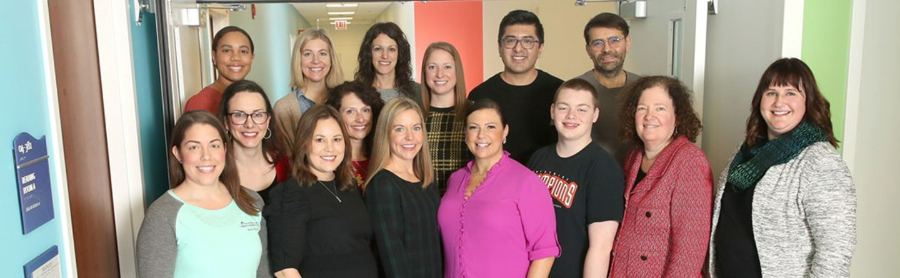 Cochlear implant team at Ann & Robert H. Lurie Children's Hospital.
The takeaway
Income inequality influences medical outcomes, even for children who receive the same life-changing technology. While a cochlear implant opens the door to hearing, socioeconomic factors determine how wide that door swings open.
- This research comes from one of the world's most experienced cochlear implant programs, which celebrated its 2,000th procedure in 2019.
- The findings should encourage important discussions about guaranteeing equal access to post-implant support services.
Our pediatric specialists can help your child
If you have concerns about your child's hearing, call 708-599-9500 to schedule a consultation with a pediatric audiologist.
★ For facts about hearing loss and hearing aid options, grab your copy of The Hearing Loss Guide.
★ Sign up for our newsletter for the latest on Hearing aids, dementia triggered by hearing loss, pediatric speech and hearing, speech-language therapies, Parkinson's Voice therapies, and occupational-hearing conservation. We publish our newsletter eight times a year.
Don't let an untreated hearing issue get in the way of your child's development.
Crest Hill, IL - 630-633-5060 | Palos Hills, IL - 708-599-9500