Over-the-counter hearing aids aimed to reduce costs and double adoption rates among older Americans with hearing loss. A survey in The Hearing Journal found that only 10% of older users chose OTC hearing aids. Cost wasn't the deciding factor.
Why it matters
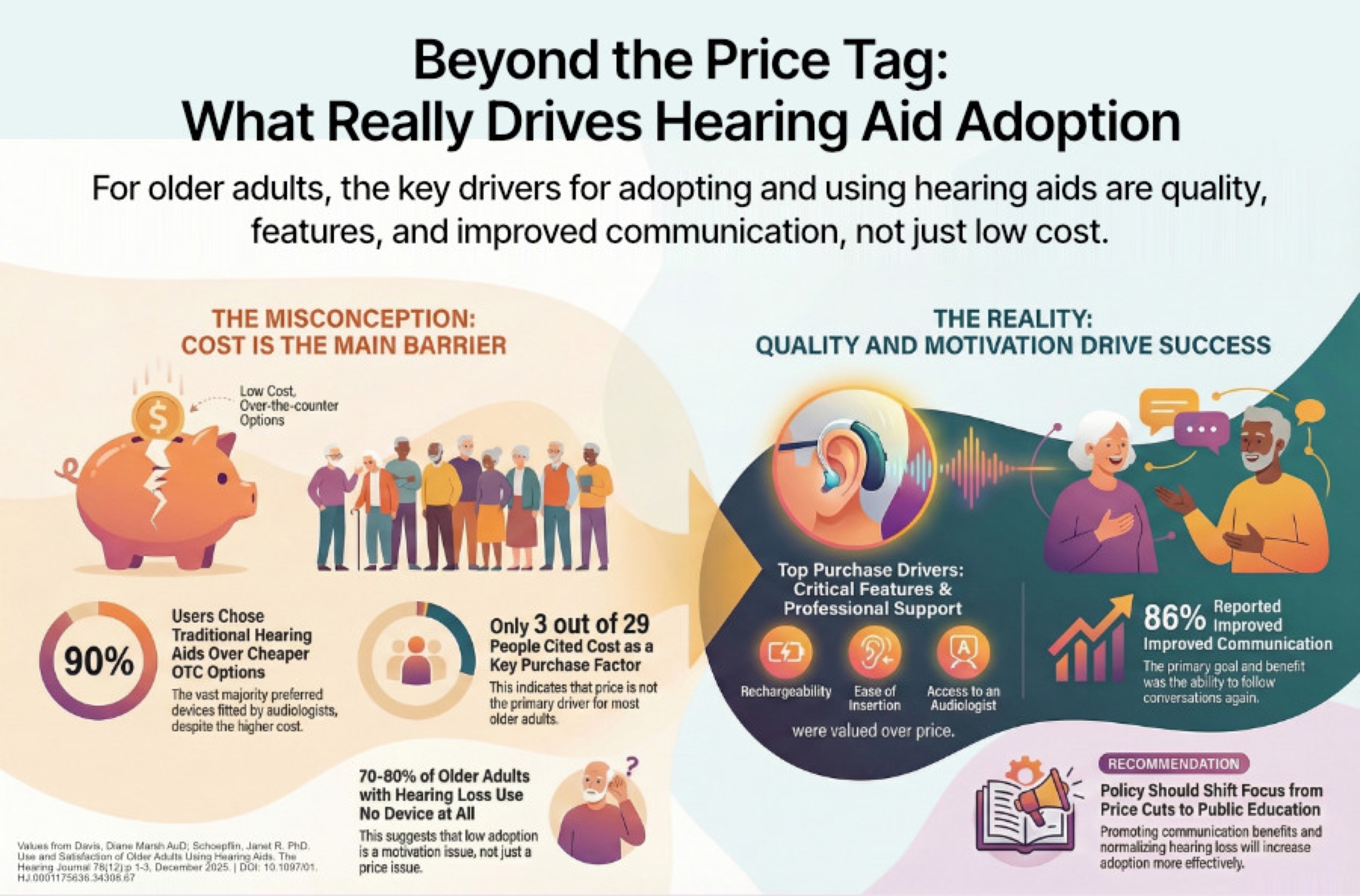
OTC hearing aids were expected to drive adoption rates due to affordability. But in this study, 90% of older adults chose traditional hearing aids fitted by audiologists, suggesting price isn't the barrier policymakers assumed.
By the numbers
-
3 of 29 retirement community residents bought OTC devices.
-
26 of 29 self-initiated their hearing aid purchase — with no family pressure
-
Only 3 people cited cost as a purchase factor (1 OTC user, 2 prescriptive)
For context: Hearing aid adoption rates among older adults with hearing loss are around 20-30% nationally, meaning 70-80% go without devices at any price.
The intrigue
Purchase sources varied widely — 54% from audiologists, 25% from big-box stores, 14% from physicians, 7% from specialists.
Primary driver: improving communication
-
Older adults want better hearing, not cheaper devices.
-
Features like easy insertion (crucial for arthritis), rechargeability (no fumbling with tiny batteries), and multiple settings mattered more than price.
-
One telling detail: A user reported abandoning cheaper aids that "did not work," then paid full price for prescriptive hearing aids. Quality beats cost.
What to know
Older adults stick with their hearing aids.
-
72% wore devices 12+ hours daily, showing a strong adherence and genuine benefit.
-
86% reported improved communication, noting they could follow dinner conversations and hear grandchildren clearly.
-
Most adjusted within two weeks.
-
Key to success: Access to your audiologist for quick troubleshooting and resolution.
 Click to download this infographic.
Reality check
This study surveyed 29 people in a single retirement community. The close-knit environment may have inflated satisfaction; residents had convenient access to providers and could swap tips with peers.
The bottom line
OTC hearing aids created an entry point but captured just 10% of users.
-
To increase hearing aid adoption, policymakers must prioritize motivation campaigns over price cuts and fund public education that normalizes hearing loss and emphasizes communication benefits, not just subsidized hearing-aid costs.
-
Common mistake: Assuming resistant family members will embrace cheaper hearing aids. This study found that motivation matters more than price. Pushing OTC devices on unmotivated users doesn't work.
Protect your hearing with a screening
Age-related hearing loss doesn't mean losing your social world or increasing your risk of dementia. Our free 15-minute hearing screening will help you:
- Understand your current hearing health
- Prevent communication barriers
- Stay engaged with loved ones
- Maintain your quality of life
Schedule your free screening today and rediscover the sounds that matter most.
★ Call 708-599-9500 to schedule your free screening.
★ For facts about hearing loss and hearing aid options, grab your copy of The Hearing Loss Guide.
★ Sign up for our newsletter for the latest on Hearing aids, dementia triggered by hearing loss, pediatric speech and hearing, speech-language therapies, Parkinson's Voice therapies, and occupational-hearing conservation. We publish our newsletter eight times a year.
Don't let untreated hearing loss spoil your enjoyment of life.
Crest Hill, IL - 630-633-5060 | Palos Hills, IL - 708-599-9500