Fitness studios are blasting music at levels that can permanently damage your hearing. A study published in JAMA Otolaryngology says they don't have to. Your workout won't suffer.
Why it matters
Turning down the volume in group fitness classes doesn't make members feel they're working less hard. Studios now have peer-reviewed cover to act. There's no evidence-based reason not to.
The problem
Loud music in fitness classes isn't incidental. Instructors and studios treat it as essential to the experience: a motivational tool. Science hasn't backed that assumption. Not at the volumes used in class.
-
Prior lab research on music and exercise peaked at 85 dBA.
-
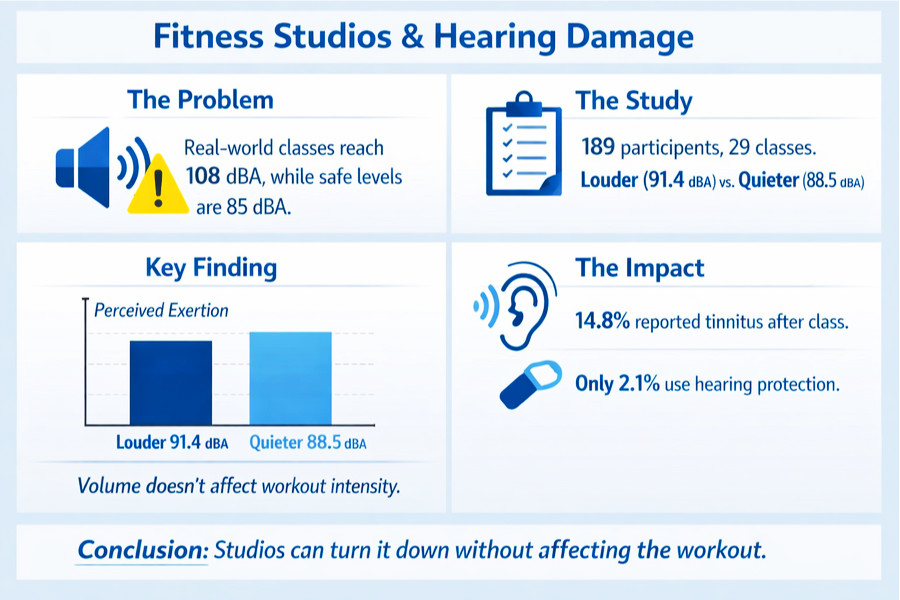
Real-world fitness classes have measured up to 108 dBA.
-
NIOSH sets the safe ceiling at 85 dBA for an 8-hour day. The first song of group fitness classes often exceeds that.
Assumptions, assumptions
Instructors and studio operators believe louder equals harder. Members feel that way too. When researchers turned the music down enough for participants to notice, workout intensity ratings didn’t drop significantly.
The minimum most people can perceive is a 3 dBA change. Noticeable reductions didn’t change how hard people felt they were working.
By the numbers
USC researchers studied 189 participants across 29 classes at a Los Angeles fitness studio. They measured perceived exertion using the validated Borg CR-10 scale, a 0 to 10 score tied to heart rate, oxygen consumption, and blood lactate.
-
Louder classes averaged 91.4 dBA.
-
Quieter classes averaged 88.5 dBA.
-
Difference in perceived exertion was −0.66 points, well below the 1.0-unit threshold to be meaningful.
-
43.9% of participants attended 3 to 5 classes weekly.
-
32.8% had attended for over 5 years.
-
14.8% reported experiencing post-class tinnitus.
-
Only 2.1% consistently used hearing protection.
This is not a one-time exposure problem. It’s a years-long accumulation, with multiple sessions per week.
A difficult truth
Nearly 1 in 6 participants experienced ringing in their ears after class, but almost nobody acted on it.
Tinnitus after a workout isn't a quirk. It's your cochlea indicating something went wrong. Research shows auditory trauma can cause permanent cochlear damage even when a standard hearing test shows nothing unusual.
People dismiss the symptom. The damage accumulates.
Yes, but
Caveat: classes weren’t randomized. Louder sessions ran first, quieter ones second. Any shift in class composition, instructor energy, or attendance patterns between phases is an uncontrolled variable.
The study skewed female at 87% and had a median participant age of 28, and was run at a single studio. There were no heart rate monitors or blood draws, just self-reported scores. The field needs larger, randomized studies.
The bottom line
Studios can turn it down. Members won't notice it in their legs, but they'll notice it in their ears. By then, it's too late.
Evidence exists. Fitness studios, instructors, and public health officials who set noise standards have no data-based reason to wait.
Protect and preserve your hearing
Noise-induced hearing loss doesn't mean losing your social world or increasing your risk of dementia. Our free 15-minute hearing screening will help you:
- Understand your current hearing health
- Prevent communication barriers
- Stay engaged with loved ones
- Maintain your quality of life
Schedule your free screening today and rediscover the sounds that matter most.
★ Call 708-599-9500 to schedule your free screening.
★ For facts about hearing loss and hearing aid options, grab your copy of The Hearing Loss Guide.
★ Sign up for our newsletter for the latest on Hearing aids, dementia triggered by hearing loss, pediatric speech and hearing, speech-language therapies, Parkinson's Voice therapies, and occupational-hearing conservation. We publish our newsletter eight times a year.
Don't let untreated hearing loss spoil your enjoyment of life.
Crest Hill, IL - 630-633-5060 | Palos Hills, IL - 708-599-9500