Your brain is a sensory melting pot, but the mix isn't always harmonious. In rats, for example, sound doesn't just accompany vision; it can block or compress what the rat sees. This finding from Italy's SISSA institute, published in PLOS Computational Biology, challenges our understanding of how the senses work together.
Why it matters
This research reveals a basic feature of how brains process information. Scientists used to think different senses were processed separately and then combined. Now we know they can directly interfere with each other.
The challenge
Earlier studies produced contradictory findings. For example, a 2008 study found auditory cues enhanced visual acuity in monkeys, but another in 2009 reported suppression in similar tasks.
The experiment
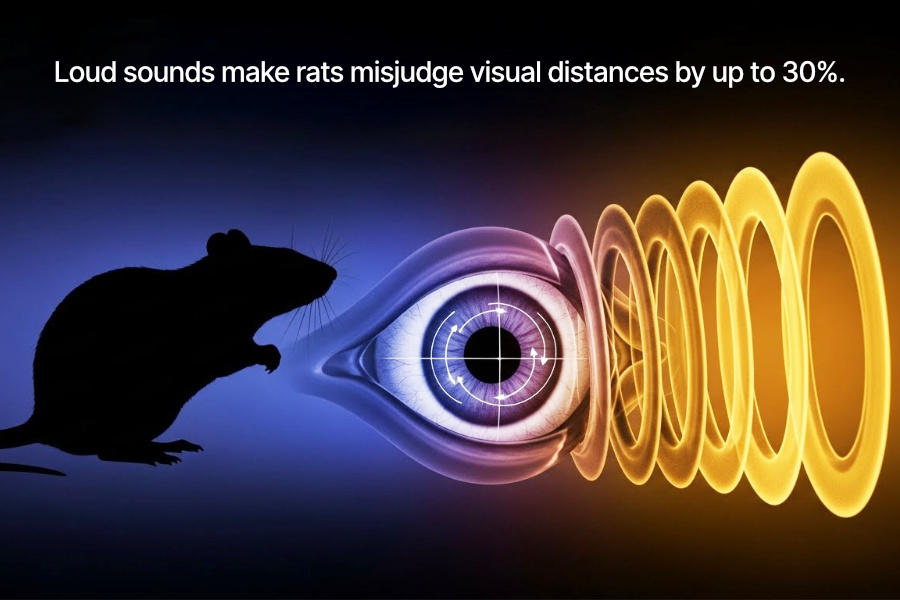
Researchers trained rats to distinguish between different speeds of moving objects. Then they added background noise. The result? The more intense the sound they introduced, the worse the rats became at seeing details. Loud sounds could make the rats misjudge visual distances by up to 30%.
A closer look
The researchers built a statistical model that predicts which auditory inputs inhibit visual neurons proportionally to sound intensity. The model matched experimental data, supporting the hypothesis that sound inhibits vision.
Yes, but:
This sensory "sabotage" might be an evolutionary advantage for rats. In the wild, hearing a predator is often more critical than seeing its exact location. So the brain might prioritize auditory information for survival.
What's Next
Scientists are now curious: Does this happen in other animals? How does it work in human brains? Research teams are planning follow-up studies to understand this mystery.
The takeaway? Brains are more complicated than imagined.