Imagine standing perfectly still, yet the world around you suddenly begins to spin. Your floor tilts unexpectedly, your balance betrays you, and for a moment, reality feels like a carnival fun house. This disorienting experience is more than just simple dizziness—it's vertigo, a complex sensory puzzle that occurs when your body's navigation system goes haywire.
Why it matters
Vertigo is a symptom, not a diagnosis—and this distinction can be life-changing. The same dizzying sensation might stem from something as harmless as misplaced ear crystals or as serious as an impending stroke. Misinterpreting these signals isn't just a medical nuance; it's a critical decision that can dramatically alter a patient's health trajectory. A missed stroke isn't just a lost hour—it can mean permanent neurological damage or, worse, a life-altering disability.
How it works
Our bodies typically maintain balance through the collaboration of the inner ear, eyes, and proprioceptive system. But sometimes, these systems disagree, sending conflicting signals to the brain. The result can be a profound sensory confusion that can make the most stable person feel out of control.
Two broad categories drive most cases:
-
Peripheral vertigo: inner ear or vestibular nerve disorders:
-
Benign Paroxysmal Positional Vertigo (BPPV)
-
Ménière disease, vestibular neuritis, labyrinthitis
-
-
Central vertigo: brainstem or cerebellar pathology: stroke, multiple sclerosis, migraine, tumors.
A closer look
The main culprit: BPPV, dislodged calcium carbonate crystals called otoconia that migrate into the semicircular canals, sending false motion signals to the brain.
BPPV attacks are brief, lasting seconds to under a minute. They occur when you roll over in bed, look up, or turn your head, then stop until the next trigger.
Vestibular neuritis? Hours to days of continuous spinning, with gradual recovery as the brain compensates.
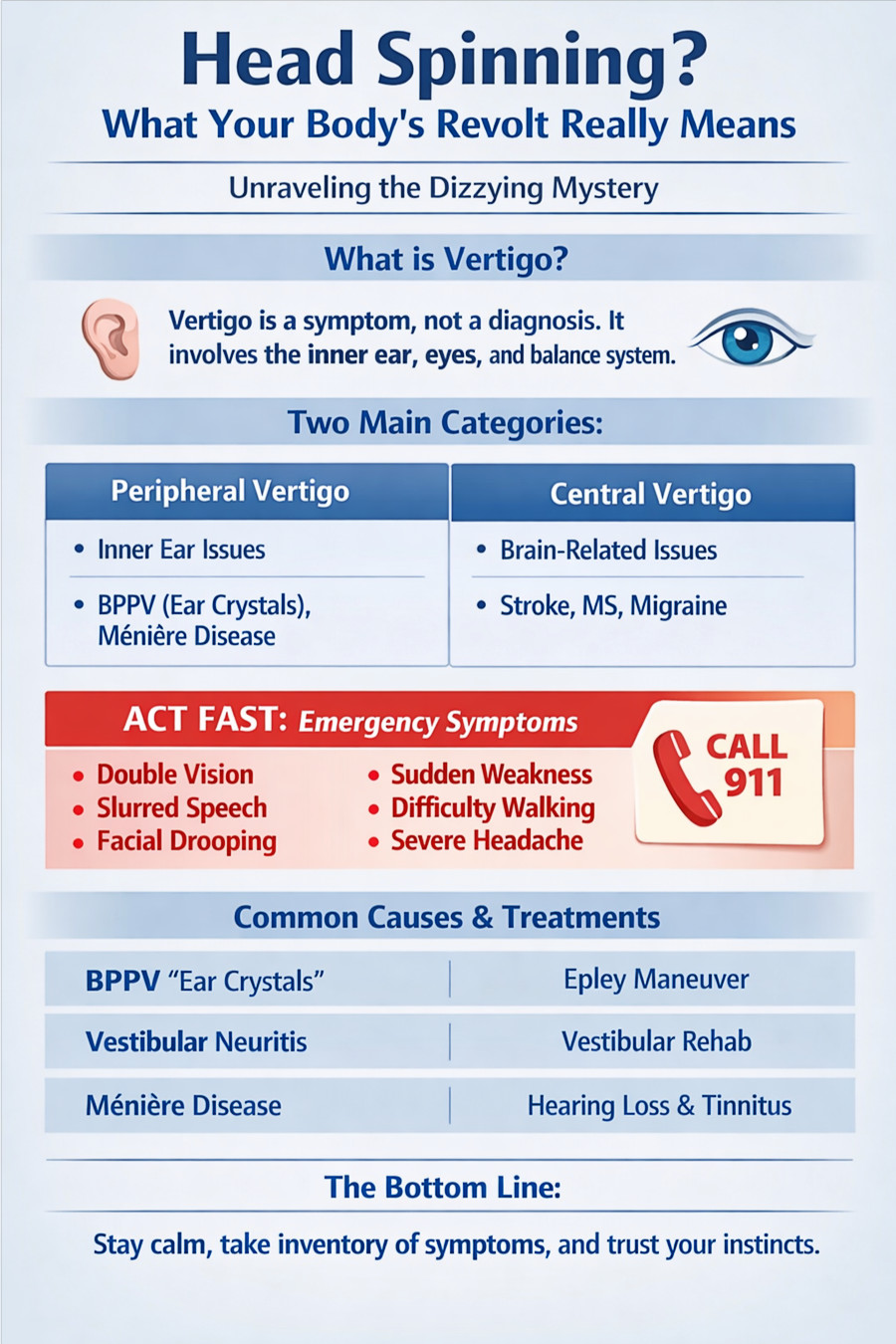 For a copy of this infographic, click it.
The challenge
Other causes hit harder and last longer:
-
Ménière disease pairs spinning with hearing loss, tinnitus, and a plugged-ear sensation.
-
Central causes add neurological red flags: double vision, slurred speech, facial asymmetry, and limb weakness.
When to act fast
Double vision, slurred speech, facial asymmetry, and limb weakness signal more than routine dizziness: they demand immediate medical attention. Central vertigo isn't a "wait and see" situation; it's a potential neurological emergency. If you experience:
-
Sudden, severe vertigo
-
Double vision
-
Slurred or difficult speech
-
Facial drooping or asymmetry
-
Sudden weakness, especially on one side of the body
-
Difficulty walking or maintaining balance
-
Severe headache accompanying dizziness
Stop what you're doing and call 911 or your local emergency number immediately.
These symptoms could indicate a stroke, brain tumor, or other serious neurological condition where every minute counts. Quick medical intervention can prevent permanent damage and potentially save your life.
Trust your instincts. If something feels seriously wrong, don't downplay your symptoms or try to tough it out.
What to know
Treatments are specific to the cause:
-
BPPV: The Epley maneuver guides displaced otoconia out of the canals through a sequence of head movements. It's first-line and non-invasive. Often curative in a single session.
-
Persistent vertigo: Vestibular rehabilitation therapy trains the brain to compensate through targeted balance and gaze exercises.
-
Acute relief: Medications like meclizine blunt nausea and spinning. Use them short-term only. Prolonged use interferes with the brain's ability to recalibrate and self-correct.
-
Infection or inflammation: Physicians prescribe steroids, antibiotics, or diuretics as needed.
The bottom line
Most vertigo resolves. Some is a medical emergency. If the room is spinning, observe your symptoms closely. Double vision, slurred speech, or sudden weakness, get medical help immediately.
Vertigo isn't a one-size-fits-all condition. While many episodes are temporary and treatable, some demand immediate attention. Your body's signals are a language. Listen carefully.
When the world starts spinning:
-
Stay calm
-
Take mental inventory of your symptoms
-
Trust your instincts
Red flags demanding immediate action:
-
Sudden, severe vertigo
-
Double vision
-
Slurred speech
-
Sudden weakness (especially on one side)
-
Difficulty walking
-
Severe, unexplained headache
Remember: In neurological symptoms, Hesitation can cost you permanent function.
Most cases of vertigo will pass. But for those rare, critical moments, your quick recognition and response can be the difference between a minor setback and a life-altering event.
Your health demands your awareness and action.
Go deeper: Coping with recurring vertigo →
Protect your hearing, preserve your balance
Hearing loss doesn't mean losing your balance, social world, or increasing your risk of dementia. Our free 15-minute hearing screening will help you:
- Understand your current hearing health
- Prevent communication barriers
- Stay engaged with loved ones
- Maintain your quality of life
Schedule your free screening today and rediscover the sounds that matter most.
★ Call 708-599-9500 to schedule your free screening.
★ For facts about hearing loss and hearing aid options, grab your copy of The Hearing Loss Guide.
★ Sign up for our newsletter for the latest on Hearing aids, dementia triggered by hearing loss, pediatric speech and hearing, speech-language therapies, Parkinson's Voice therapies, and occupational-hearing conservation. We publish our newsletter eight times a year.
Don't let untreated hearing loss spoil your enjoyment of life.
Crest Hill, IL - 630-633-5060 | Palos Hills, IL - 708-599-9500