More than 20 bird species across four continents use the same alarm call when they spot a cuckoo trying to sneak an egg into their nest. The kicker? Despite 53 million years of evolution, they all understand each other.
Why it matters
This cross-species communication hints that language may have originated by repurposing instinctive sounds for new threats.
The big picture
-
Cuckoos are brood parasites. They dump their eggs in other birds' nests and trick the hosts into raising their chicks.
-
About 100 species worldwide pull this con, but host birds have evolved a countermeasure: a distinctive "whining" call that triggers aggressive mobbing behavior.
By the numbers
-
21 bird species produce similar alarm calls
-
53 million years since these species last shared a common ancestor
-
Species span Australasia, Africa, Asia, and Europe
How it works
Dr. Will Feeney at Spain's Doñana Biological Station played recordings of alarm calls from one continent to birds on another. The results were striking.
Australian and Chinese birds responded to foreign alarm calls as quickly as their own species' warnings. They mobbed aggressively to drive the threat away.
"This indicates that the function of this vocalisation is to facilitate communication across species rather than just within," Will Feeney, PhD, The University of Queensland, Australia
The intrigue
These birds inhabit areas crowded with brood parasites that exploit multiple hosts. The alarm call may recruit nearby birds to help with the mobbing.
"Brood parasites represent this very unique kind of threat. They are an enormous threat to your offspring but not at all a threat to you." — Dr. Feeney
Reality check
Not everyone believes it's an ancient shared language.
“It might not be that they have an ancestral, ancient shared alarm towards brood parasites, but rather it might actually just be that there is a specific acoustic feature that seems to be quite successful at driving away brood parasites.” — Rose Thorogood, PhD, University of Helsinki
A closer look
When researchers played the whining call to North American yellow warblers (which don't produce this alarm), the birds rushed back to their nests instead of mobbing. They recognized it as a distress signal but hadn't learned the response.
The bottom line
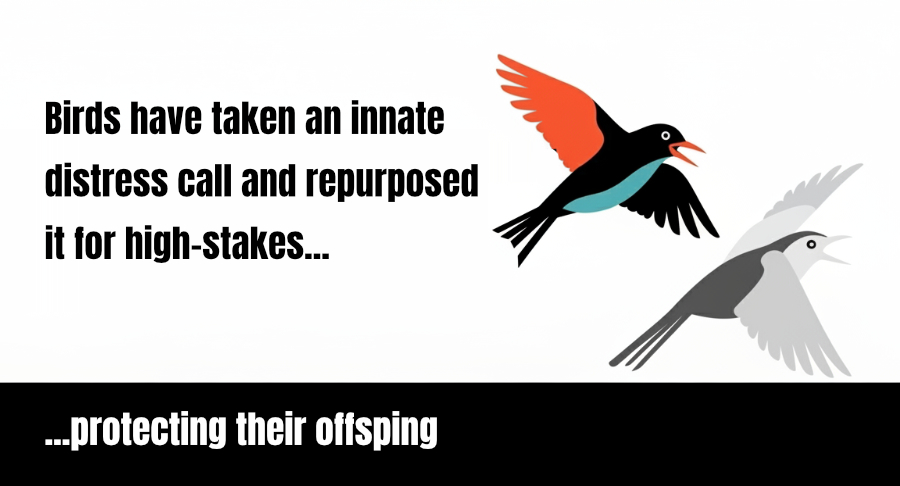
Birds have repurposed an innate distress call for a high-stakes situation: protecting their offspring. Charles Darwin speculated that language might trace back to this adaptation, modifying instinctive sounds for new contexts.
One researcher noted: Animal communication and human language appear to be on a continuum, not separated by an unbridgeable gap.