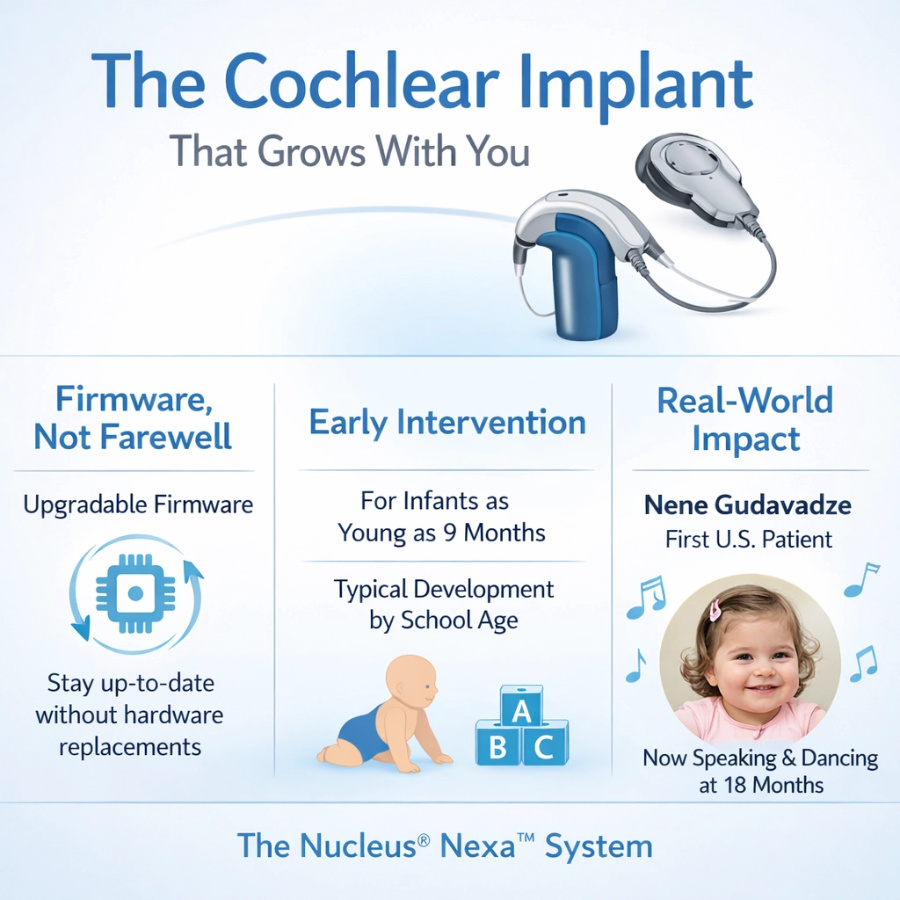
When Nene Gudavadze was diagnosed with severe bilateral sensorineural hearing loss six months ago, she had failed every newborn hearing screening. Now, at 18 months old, she's a different child—saying "mama" and dancing with joy to music.
Last August, Nene became the first U.S. patient to receive the newly FDA-cleared Nucleus Nexa cochlear implant system. Her progress is forcing doctors to rethink early intervention.
Why it matters
Early detection and treatment of hearing loss lead to better developmental outcomes. It's not just about whether a child gets help, but when. The Nucleus Nexa is cleared for infants as young as 9 months old.
Research from NYU Langone's Cochlear Implant Center confirms that children implanted before one develop vocabulary and communication skills within the typical range by school age.
Families can now address childhood hearing loss faster and more effectively.
How it works
The Nucleus Nexa, built by Cochlear Limited, is the first cochlear implant with upgradable firmware.
- Instead of replacing the external processor with each sound-processing technology advance, the implanted device receives firmware updates directly, no new hardware required.
- Most implants lock patients into the surgery’s technology. The Nucleus Nexa breaks that pattern.
- For a child growing up in the next two decades, the difference is substantial.
By the numbers
- Children implanted before age one develop vocabulary and communication skills within the typical developmental range by school age.
- Nene was diagnosed with severe bilateral sensorineural hearing loss after failing multiple newborn screenings.
- Her implant was installed at NYU Langone Health by Dr. Sean O. McMenomey. At 6 months post-activation, Nene responds to sound, produces words, and reacts to music.
- NYU Langone's Cochlear Implant Center treats several hundred patients annually.
The intrigue
Repeated hardware upgrades meant new external processors, new fittings, and an ongoing burden on growing children and their families. Firmware updates sidestep that cycle. This device stops forcing families to choose between their child's current hearing and the next technology.
Zoom in
Nene's mom, Natia Kikutadze, navigated uncharted territory. Hearing loss was a foreign concept in her family's medical history—a sudden, unexpected diagnosis that shattered her expectations. With no prior experience or family precedent, the news initially felt overwhelming, leaving her searching for understanding and hope.
She called the surgery “a new beginning.” Six months later, her daughter tries to sing.
Looking ahead
Nene's case is promising, marking an exciting first chapter in Nucleus Nexa's product evolution. Cochlear Limited's innovative approach invites further research and improvement.
The firmware update capability opens conversations about adaptive medical technologies. Future investigations will explore the full potential of this approach, tracking developmental milestones and technological adaptability.
Cochlear Limited is committed to supporting emerging technologies, suggesting a robust framework for future maintenance and updates. Nucleus Nexa’s design is a proactive approach to addressing potential technological limitations.
The takeaway
Decades of research support early implantation. What's new is a device that stops families from choosing between acting now and benefiting later.
Nene is 18 months old, her world alive with sound, and dancing to music. For children like her, the window of possibility has opened wider, promising a future where hearing loss means opportunity, not silence.
Healthy children's hearing starts here
Safeguard your child's development with a hearing consultation with a pediatric audiologist. This quick check provides peace of mind, establishes a healthy baseline, and ensures your child is on track for learning and social success.
★ Call 708-599-9500 to schedule.
★ For facts about hearing loss and hearing aid options, grab your copy of The Hearing Loss Guide.
★ Sign up for our newsletter for the latest on Hearing aids, dementia triggered by hearing loss, pediatric speech and hearing, speech-language therapies, Parkinson's Voice therapies, and occupational-hearing conservation. We publish our newsletter eight times a year.
Don't let untreated hearing loss spoil your child's intellectual and social development.
Crest Hill, IL - 630-633-5060 | Palos Hills, IL - 708-599-9500