Most adults with age-related hearing loss wait 7 to 10 years before taking action. One in three adults over 50 has the condition. That gap may be accelerating cognitive decline.
Why it matters
Hearing loss doesn't just muffle sound; it changes brain function. University of Colorado Boulder auditory neuroscientist Anu Sharma, PhD, has studied how the brain responds to sound deprivation for 20 years. She observes this in real time using EEG caps with 128 electrodes. Her findings show the damage starts earlier than expected.
By the numbers
-
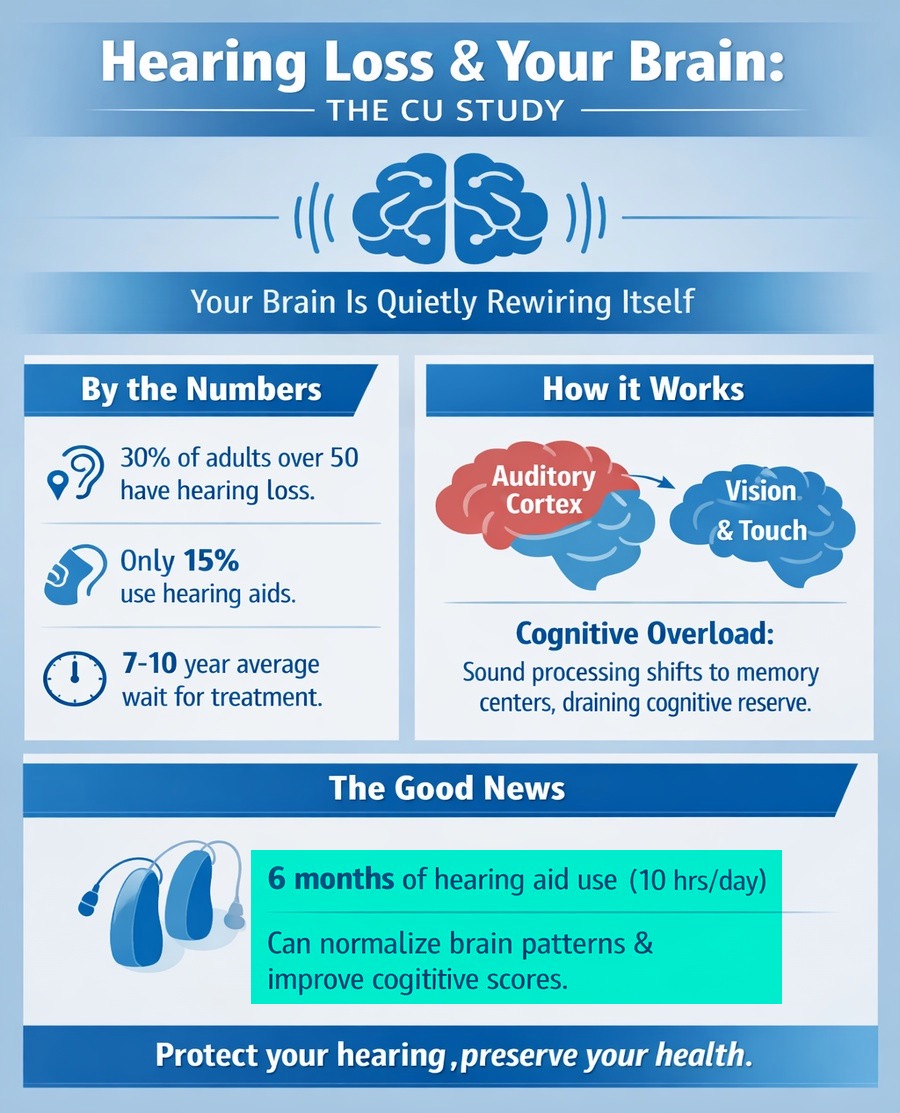
30% of adults over 50 have age-related hearing loss.
-
Only 15% of those who could benefit from hearing aids use them.
-
Adults wait 7 to 10 years on average before seeking treatment.
How it works
The brain hates wasted space. When the auditory cortex stops receiving adequate sound, it gets reassigned to handle vision and touch. In profoundly deaf individuals, this rewiring can sharpen face recognition and heighten the sense of touch. In people with mild hearing loss, it drains their memory.
“It is a dynamic and elegant plasticity. And for a long time, we had only seen it in children who were born deaf or adults who were profoundly deaf.” —Dr. Sharma
The catch:
-
Sound processing doesn't disappear; it shifts to memory and cognition centers.
-
Researchers theorize that cognitive overload drains "cognitive reserve" over time.
-
In Dr. Sharma's studies, untreated hearing loss worsens cognitive task performance.
Reality check
Associated is not the same as caused. The headlines have outrun the science. Some hearing aid companies claim their products prevent Alzheimer's. Nobody can prove that. Not yet.
Yes, but
Sharma's 2020 study, small (21 participants), showed something worth watching. Adults who wore hearing aids for six months, averaging 10 hours a day, saw brain activity patterns normalize. The cross-modal rewiring was partially reversed. Most scored better on cognitive tests.
A 2023 randomized controlled trial found no population-wide cognitive benefit. People with cardiovascular disease showed gains. Why that subgroup responded differently is not understood. It may be the most important unanswered question in the field.
In the meantime
There are many other reasons to seek treatment for age-related hearing loss, such as avoiding social isolation and depression.
“Regardless of the cognitive issues, if you have hearing loss, it’s really smart to get hearing aids. They will enhance your quality of life.” —Dr. Sharma
Protect your hearing, preserve your health
Hearing loss doesn't mean losing your social connections or increasing your risk of falling and dementia. Our free 15-minute hearing screening will help you:
- Understand your current hearing health
- Prevent communication barriers
- Stay engaged with loved ones
- Maintain your quality of life
Schedule your free screening today and rediscover the sounds that matter most.
★ Call 708-599-9500 to schedule your free screening.
★ For facts about hearing loss and hearing aid options, grab your copy of The Hearing Loss Guide.
★ Sign up for our newsletter for the latest on Hearing aids, dementia triggered by hearing loss, pediatric speech and hearing, speech-language therapies, Parkinson's Voice therapies, and occupational-hearing conservation. We publish our newsletter eight times a year.
Don't let untreated hearing loss spoil your enjoyment of life.
Crest Hill, IL - 630-633-5060 | Palos Hills, IL - 708-599-9500