Not all hearing loss announces itself with a dramatic drop in volume. A new study from India finds a more insidious risk for young adults with high recreational noise exposure: subtle auditory damage that standard tests can’t capture.
Why it matters
Millions of young adults think that when hearing loss isn't detected on a test their hearing is fine. But that logic is flawed.
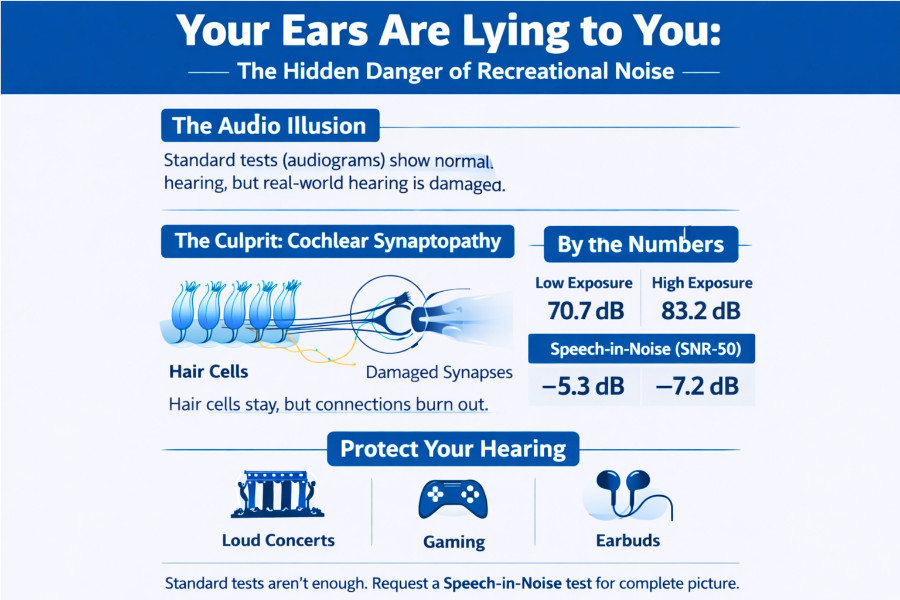
Researchers found that high-noise-exposed participants (loud concerts, gaming, loud earbuds) performed worse at understanding speech in noisy environments, despite having normal pure-tone audiograms, otoacoustic emissions, and middle ear function. (All confirmed by objective testing.)
The two study groups were statistically identical on every standard measure. The only difference was their real-world hearing ability.
By the numbers
The study enrolled 50 young adults (ages 18–30), split into low and high noise exposure groups based on annual noise levels.
- High-exposure group: mean 83.2 dB annual noise exposure
- Low-exposure group: mean 70.70 dB
- Speech-in-noise performance (SNR-50): −5.3 dB (high exposure) vs. −7.2 dB (low exposure)
- That gap was statistically significant: p < 0.001
How it works
The culprit is cochlear synaptopathy. Think of it as the wiring between your inner ear and brain burning out. The hair cells stay intact, but the connections between them and the auditory nerve erode. Standard tests measure the hair cells, not the wiring.
Noise exposure kills low spontaneous rate (LSR) nerve fibers, which are essential for hearing your colleague speak in a noisy conference room. Once those fibers are gone, they don’t regenerate. There is no treatment or reversal.
A difficult truth
Many young adults are not careful with their ears. Unlike occupational noise, recreational exposure has no monitoring, regulation, or enforcement.
The researchers stated that non-occupational noise "often occurs repetitively at dangerously high intensities, with no regulation or monitoring." No one is watching or warning them.
Yes, but
The study found no statistically significant difference in amplitude modulation detection between the two groups, a measure of how effectively the auditory system tracks sound fluctuations.
Researchers cite within-group variability and a limited sample size as likely reasons the difference wasn't statistically significant. The trend existed, but the study couldn't confirm it.
The bottom line
Pass your standard hearing test for valuable baseline information. Emerging research offers insights to further protect your hearing. Speech-in-noise testing complements existing protocols, providing a comprehensive understanding of auditory health.
- If you're a regular concert-goer, gamer, or earbud user, be proactive about your hearing health. Next time you see an audiologist, request a comprehensive evaluation with speech-in-noise testing.
- This advanced screening goes beyond standard audiometry, giving you a complete picture of your auditory well-being.
Protect your hearing, preserve your connection
Noise-induced hearing loss doesn't mean losing your social world or increasing your risk of dementia. Our free 15-minute hearing screening with an audiologist will help you:
- Understand your current hearing health
- Prevent communication barriers
- Stay engaged with loved ones
- Maintain your quality of life
Schedule your free screening today and rediscover the sounds that matter most.
★ Call 708-599-9500 to schedule your free screening.
★ For facts about hearing loss and hearing aid options, grab your copy of The Hearing Loss Guide.
★ Sign up for our newsletter for the latest on Hearing aids, dementia triggered by hearing loss, pediatric speech and hearing, speech-language therapies, Parkinson's Voice therapies, and occupational-hearing conservation. We publish our newsletter eight times a year.
Don't let untreated hearing loss spoil your enjoyment of life.
Crest Hill, IL - 630-633-5060 | Palos Hills, IL - 708-599-9500